Introduction
Hiring the right candidate involves more than evaluating qualifications, experience and interview performance. Employers must also understand whether a candidate’s background presents any relevant legal, criminal or regulatory risks that could affect the organisation.
This is where Legal History Verification becomes an important part of employee background screening. It helps employers assess relevant criminal records, court proceedings, police records and regulatory information before completing the onboarding process.
For organisations hiring across multiple locations or countries, verification can become more complex because legal databases, court systems and screening requirements vary by jurisdiction.
Understanding which checks are relevant, how they work and when they should be conducted helps HR teams make informed hiring decisions while supporting legal and regulatory compliance.
1. What Is Legal History Verification in Employee Background Screening?
Legal History Verification is the process of reviewing relevant legal, criminal and regulatory information associated with a prospective employee. It helps employers identify potential risks that may affect workplace safety, organisational reputation, regulatory obligations or job-related responsibilities.
Depending on the role, location and applicable requirements, this verification may include:
- Criminal and Civil Court Record Check (E-Court Check)
- Police verification and police clearance certificates
- Covered within the E-Court check; this includes relevant criminal and civil court records.
Not every employee requires every type of verification. Employers should select checks based on the nature of the role, the level of access or responsibility involved, local regulations and legitimate business requirements.
2. What Types of Legal and Criminal Background Checks Should Employers Conduct?
The checks included in an employee screening programme depend on the organisation’s industry, hiring location and risk assessment. The following are common verification categories employers may consider before onboarding.
A. Criminal Record Verification and Police Checks
Criminal record verification helps employers identify relevant available criminal history associated with a candidate. It can be particularly important for positions involving financial responsibility, sensitive information, vulnerable individuals or security-related duties.
In India, the E-Court check is the criminal and civil court-record verification. For international requirements, GSS conducts jurisdiction-specific criminal record checks through the relevant available sources and verification channels.
In India, GSS conducts an E-Court check covering criminal and civil court records across jurisdictions, including lower courts, High Courts, the Supreme Court and other relevant tribunals such as the NCLT. PCC and PVC are separate police-level checks and are generally limited to the relevant state-level process.
For international hiring, criminal-record verification methods vary by country. Depending on the jurisdiction and scope, checks may include:
🟦 United Kingdom: Disclosure and Barring Service (DBS) checks, where the role and eligibility requirements permit.
🟦 United States: Relevant county, federal and national criminal record searches, depending on the screening scope.
🟦 Other jurisdictions: Local police records, criminal databases or authorised verification channels, where available.
Employers should understand that database coverage and record availability differ between jurisdictions. A search result should also be reviewed carefully rather than treating an allegation or pending case as proof of guilt.
B. E-Court Check: Criminal and Civil Court Record Verification
Court Record Verification involves reviewing relevant judicial records to identify available.
The E-Court check covers criminal and civil court-record verification. It involves researching relevant judicial records across available court levels and jurisdictions to identify records associated with a candidate.
This can help organisations understand whether a candidate has relevant litigation history that may require further assessment, particularly for positions involving legal responsibility, financial authority or sensitive business operations.
In India, the E-Court check may cover the following court levels and forums, subject to record availability:
- District and other lower-court records
- High Court records
- Supreme Court records
- Relevant criminal and civil proceedings across the covered court levels
- Available case details and judicial records
GSS’s E-Court check is designed to cover court records across India, including lower courts, High Courts, the Supreme Court and relevant tribunals such as the NCLT. This is distinct from PCC/PVC checks, which operate through police-level channels and are limited to the relevant state-level process.
It is important to distinguish between a court record, a pending proceeding and a final conviction. Employers should review the context and relevance of any finding before making an employment decision.
C. LSEG World-Check: AML, PEP, Sanctions, Watchlists and Adverse Media Screening
Organisations operating internationally or working in regulated industries may need additional checks to assess financial crime and regulatory exposure.
GSS uses LSEG World-Check as a consolidated screening database for multiple financial-crime, regulatory and reputational-risk categories, including:
🟦 AML Screening: Supports the identification of potential associations with money laundering and related financial-crime risks through the database’s relevant records and indicators.
🟦 PEP Screening: Identifies individuals who hold or have held prominent public positions, along with relevant associated persons and family members, in line with applicable screening standards.
🟦 Sanctions and Watchlist Screening: Checks relevant national and international sanctions lists and watchlists. Depending on the screening scope, sources may include OFAC, INTERPOL, FBI-related watchlists and other relevant databases.
LSEG World-Check brings together multiple screening categories and data sources, including AML, PEP, sanctions, watchlists and adverse media. GSS uses this database to support screening based on the client’s requirements and applicable scope.
A potential database match should be verified using identifying information and reviewed in context. A match alone does not establish wrongdoing.
D. Adverse Media and Social Media Screening: Separate Verification Areas
Adverse media screening is included within LSEG World-Check. It helps identify relevant publicly reported information that may indicate potential legal, financial, ethical or reputational concerns.
Separately, GSS’s social media verification is an automated, AI-native check that reviews publicly accessible records and other online behaviour available within the defined scope. Adverse media and social media verification should therefore not be treated as the same check.
- Examples of adverse media indicators may include reported financial misconduct
- Fraud-related reporting
- Regulatory investigations
- Corruption-related reporting
- Other relevant legal or reputational concerns
Employers should avoid relying on unverified posts, personal opinions or unrelated personal information. Any finding should be assessed for accuracy, context and job relevance.
E. Right to Work and Additional Statutory Compliance Checks
Legal and statutory verification may extend beyond criminal and court records. Employers may also need to confirm whether candidates meet applicable employment eligibility and regulatory requirements.
Depending on the country and role, additional checks may include:
- Right to Work validation
- Relevant regulatory database checks
- Professional or role-specific compliance verification
- Other statutory checks required for particular industries
These checks help organisations confirm that the candidate meets relevant employment or regulatory requirements before onboarding.
Comparison of Common Legal History and Compliance Checks
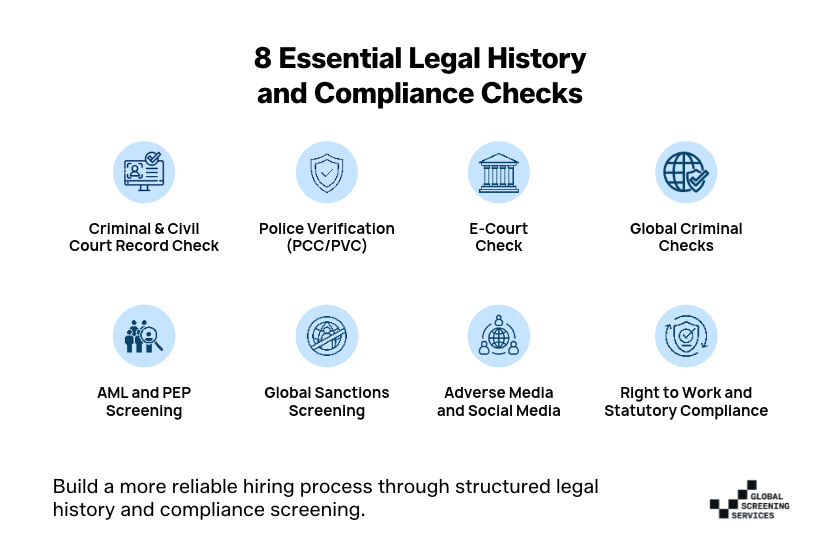
8 Essential Legal History and Compliance Checks
The infographic should summarise these eight verification areas:
- Criminal & Civil Court Record Check
- E-Court Check
- Police Verification
- AML Screening
- PEP Screening
- Global Sanctions Screening
- Adverse Media Screening
- Right to Work Verification
| Verification Type | What It Checks | Business Relevance |
|---|---|---|
| Criminal & Civil Court Record Check | Available criminal and civil court records and proceedings | Legal history assessment |
| E-Court Check | Court records available through India’s e-Courts system | Digital court record verification |
| Police Verification | Relevant police records and police verification certificates | Background validation |
| AML Screening | Potential money laundering-related risks | Financial crime compliance |
| PEP Screening | Politically exposed persons | Enhanced due diligence |
| Global Sanctions Screening | Applicable sanctions lists and watchlists | Regulatory risk management |
| Adverse Media Screening | Relevant negative news coverage | Reputational risk assessment |
| Right to Work Verification | Employment eligibility | Statutory compliance |
Key Insight “Effective employee screening goes beyond checking criminal records. It requires a structured approach to court research, regulatory database screening and jurisdiction-specific verification to help organisations identify potential legal and compliance risks before onboarding.”
How Does GSS Manage the Verification Process?
GSS follows a structured, seven-stage verification process, from candidate intake and document validation through initiation, source follow-up, outcome assessment and quality review before report release.
For legal-history screening, the relevant checks are initiated using source-specific procedures. The overall workflow follows these stages:
Step 1: Candidate Submission and Intake
The case is received through the agreed intake channel. Candidate documents are collected on a consent-based basis, and the screening scope is aligned with the client’s requirements.
Step 2: Document Validation
The candidate’s declared details are cross-checked against the supporting documents received for the relevant verification component.
Step 3: API-Led Database Check
The selected checks are processed automatically through API integrations. Relevant candidate details are used to search the applicable databases.
Step 4: Outcome Response
The system retrieves the database response and makes the available verification information accessible for review.
Step 5: Verifier Outcome Decision
The verifier reviews the database response and supporting details to assess the findings and determine the verification outcome. Any discrepancies are evaluated based on the available information.
Step 6: Quality Control and Quality Assurance
Before release, the report undergoes component-level quality control and quality assurance to check the accuracy and consistency of the recorded findings.
4. What Should Employers Consider for Legal Compliance?
Legal history screening must be conducted responsibly. Employers should consider the following factors when designing or managing their verification programmes.
🟦 Applicable laws and regulations: Screening requirements differ across countries, states and industries. Confirm which checks are permitted or required in the relevant jurisdiction.
🟦 Candidate consent and transparency: Obtain appropriate consent or authorisation and explain the purpose of the checks where required.
🟦 Data protection: Collect, access, store and share candidate information in accordance with applicable privacy and data protection requirements.
🟦 Role relevance: Select checks that are proportionate to the responsibilities and risks associated with the position.
🟦 Accuracy and verification: Validate potential matches and distinguish confirmed findings from allegations, pending cases or incomplete records.
🟦 Fair assessment: Give relevant context appropriate consideration rather than automatically rejecting candidates based on an isolated database result.
🟦 Record management: Maintain appropriate documentation and access controls for screening reports.
🟦 Legal History Screening: India and International Considerations
The screening scope should reflect the country, industry, role and applicable requirements. Examples include:
- India: Consider the E-Court check for criminal and civil court records across covered court levels and jurisdictions.
- India: Consider PCC/PVC separately where required. These are state-level police checks and may be renewed periodically in sectors such as driver and fleet operations.
- International: Identify the relevant country-specific criminal record checks and verification channels.
- International and regulated-sector screening: Consider LSEG World-Check for AML, PEP, sanctions, watchlists and adverse media, according to the required scope.
- For sectors such as BFSI, organisations may conduct periodic court checks and international database screening. The frequency may be quarterly or annual, depending on data sensitivity and industry requirements.
- Confirm the required screening frequency and scope with the client, taking account of applicable regulatory and organisational requirements.
- Review adverse media through LSEG World-Check and treat social media verification as a separate check.
- Review and validate potential matches and discrepancies against the available source information.
- Review the verification report and any source limitations.
- Make the onboarding decision in line with company policy and applicable regulations.
Important: This checklist is a planning aid, not a universal list of mandatory checks. The appropriate screening scope depends on the role, jurisdiction and applicable legal requirements.
5. How to Choose the Right Legal History Verification Provider?
Selecting a reliable verification provider is important for maintaining an effective and consistent employee screening process. Employers should evaluate providers based on their coverage, research methods, reporting standards and ability to support relevant compliance requirements.
Consider the following factors:
1. Jurisdictional Coverage
Choose a provider that can support the locations where your organisation hires. International screening may require access to different court systems, police verification channels and regulatory databases.
2. Reliable Research and Verification Methods
Understand how the provider sources and validates information. For court searches, ask about the jurisdictions covered, available records and any legal research support involved.
3. Regulatory Database Screening
For organisations with relevant financial or regulatory exposure, check whether the provider can support AML, PEP and sanctions screening through appropriate databases.
4. Clear and Traceable Reporting
Screening reports should present findings clearly, identify relevant limitations and help HR or compliance teams understand the results.
5. Data Protection and Consent Management
Review how the provider handles candidate information, consent, confidentiality and data protection obligations.
6. Scalable Screening Support
Choose a provider that can support the organisation’s hiring volume and geographical requirements without compromising verification quality.
Legal History Verification Support from Global Screening Services
Global Screening Services (GSS) supports organisations with legal history and statutory compliance screening across Indian and international jurisdictions.
GSS’ services include India-wide E-Court checks covering criminal and civil court records, separate PCC/PVC police verification where required, international criminal checks and LSEG World-Check screening across AML, PEP, sanctions, watchlists and adverse media. Social media verification is offered as a separate automated, AI-native check.
Depending on the requirement and jurisdiction, GSS uses technology-enabled research, relevant verification sources and legal research support to help organisations obtain structured screening information.
To understand the available services and verification coverage, explore GSS Legal History & Statutory Compliance Services.
Frequently Asked Questions
1. What Is Included in Legal History Verification During Employee Background Checks?
Legal History Verification may include criminal record checks, police verification, court record research, litigation searches, AML and PEP screening, sanctions screening and adverse media checks. The exact scope depends on the candidate’s role, location and applicable requirements.
2. How Do Employers Conduct Criminal Record Verification Before Onboarding?
Employers generally collect the required candidate information and consent, where applicable, and initiate criminal record checks through relevant authorities, databases or verification providers. The available process and record coverage vary by jurisdiction.
3. What Is the Difference Between Court Record Verification and Police Verification?
Court Record Verification involves reviewing available judicial records and relevant court proceedings. Police Verification involves checks through relevant police authorities or police verification channels. Both provide different types of background information and may be used together where appropriate.
4. What Does the E-Court Check Cover in India?
Criminal records cannot be accessed independently at all court levels at an individual level. It is best to partner with an ISO 27001 background verification agency to do this.
5. What Is Included in Global Legal and Compliance Screening?
International legal screening depends on the country and available verification sources. GSS can conduct jurisdiction-specific criminal checks and use LSEG World-Check for AML, PEP, sanctions, watchlists and adverse media screening. The scope should be defined according to the organisation’s requirements and applicable jurisdiction.
6. Is Legal History Verification a One-Time Check?
Legal History Verification is often conducted once before onboarding, but most enterprises and organisations carry out periodic or event-based rescreening for roles with ongoing regulatory or security requirements. The frequency should follow applicable laws, company policy and legitimate business needs.
7. How Long Does Legal History Verification Take in India and Internationally?
The turnaround time for legal history verification depends on the type of check, jurisdiction, source procedures, and response time.
For database-based checks, such as E-Court (Criminal and Civil) checks and LSEF, the typical turnaround time is within 24 hours. However, Physical Verification Checks (PVC) may take longer, as timelines vary from state to state and depend on the candidate’s cooperation. The end-to-end turnaround time for PVC generally ranges from 7 to 21 days.
For international checks, the turnaround time may vary depending on the country, verification source, and applicable procedures. Therefore, the expected TAT should be confirmed for the specific check and location.
8. How Does Legal History Screening Differ Between India and Other Countries?
In India, GSS’s E-Court check covers criminal and civil court records across covered court levels and jurisdictions, while PCC/PVC are separate state-level police checks. For international hiring, the checks depend on the country’s available records and verification channels and may include jurisdiction-specific criminal checks and LSEG World-Check screening.