Introduction
Workplace safety is a priority for organisations, particularly in industries where impairment can create operational risks. Employee drug testing helps employers screen for the presence of specified substances and establish a more reliable, safety-conscious workforce.
However, companies need to understand when testing is appropriate and which employees or situations may require screening. From pre-employment checks to random and periodic testing, the timing depends on job responsibilities, workplace risks, client requirements and applicable regulations.
A structured employee drug testing programme helps HR teams manage screening consistently while protecting employee privacy and supporting informed workplace decisions.
Why Is Employee Drug Testing Important in the Workplace?
Drug testing can form part of an organisation’s workplace safety and risk management programme. It is particularly relevant in manufacturing, logistics and maritime environments, where substance-related impairment may create safety concerns.
Companies may use workplace drug testing to:
- Support safer working conditions in high-risk environments.
- Meet pre-employment screening standards set by international vendors and clients.
- Prepare employees for project deployment and site-access requirements.
- Support internal HR policies and relevant industry-specific requirements.
- Strengthen workforce reliability and protect organisational reputation.
The objective is to establish a screening programme that reflects genuine workplace and operational requirements rather than testing employees without a defined purpose.
6 Key Situations When Companies Should Conduct Employee Drug Testing
The timing of employment drug testing depends on the organisation’s policies, job responsibilities and applicable requirements. The following are six situations in which employers may consider screening.
1. Pre-Employment Drug Testing
Pre-employment drug testing is conducted during recruitment, generally before a candidate joins an organisation or receives final deployment approval.
It may be relevant for safety-sensitive positions and roles involving machinery, transportation or other operational responsibilities. International vendors and global clients may also require candidates to complete pre-employment drug tests before project deployment.
Employers should communicate the requirements to candidates in advance and explain the collection and reporting process.
2. Random Drug Testing
Random testing involves selecting employees for screening at unannounced intervals under an established workplace policy.
Companies may consider random employee drug screening in environments where ongoing workplace safety and compliance are important. It can help organisations maintain consistent screening standards rather than limiting checks to the hiring stage.
Selection procedures should be clearly defined, consistently applied and compliant with applicable legal and privacy requirements.
3. Reasonable Suspicion Drug Testing
Reasonable suspicion drug testing may be considered when specific, documented observations create a legitimate concern about possible impairment at work.
Examples may include:
- Observable signs of impairment.
- Unusual behaviour affecting workplace safety.
- Difficulty carrying out safety-sensitive responsibilities.
- Specific workplace incidents supported by documented observations.
Employers should avoid relying on rumours, assumptions or personal bias. Any testing should follow the organisation’s policy and applicable requirements.
4. Post-Accident or Incident-Based Drug Testing
Post-accident testing may be considered after a workplace accident, safety incident or near miss when substance use could be relevant to the investigation.
This consideration may be particularly important in manufacturing, logistics, transportation and maritime environments.
However, an accident does not automatically establish substance use or impairment. Employers should document the circumstances, follow established incident-response procedures and comply with applicable requirements before initiating testing.
5. Periodic or Scheduled Drug Testing
Periodic drug testing involves screening employees at predetermined intervals. Organisations may consider it for roles with ongoing safety, client or regulatory requirements.
Unlike random testing, periodic screening follows a planned schedule. Its frequency should reflect the organisation’s risk assessment, internal policies and applicable industry requirements.
GSS confirms that it can facilitate random and periodic screening to support ongoing workplace safety and compliance.
6. Testing When Prescription Drug Misuse Is a Concern
Certain prescription medications, including sedatives or tranquilizers, may affect alertness or coordination. Employers may need to address concerns about possible prescription drug misuse when there is a legitimate workplace safety reason.
However, taking prescribed medication does not automatically indicate misuse or impairment. A drug screening result alone does not establish misuse, and employers should protect medical confidentiality and arrange appropriate review before making employment decisions.
GSS’s 6-panel screening includes benzodiazepines, while its 9-panel includes additional substances such as barbiturates and methadone. These panel options provide substance screening; they should not be presented as a medical diagnosis or a standalone assessment of prescription misuse.
Quick Comparison: When Should Companies Conduct Drug Testing?
| Testing Situation | When It May Be Considered | Main Objective |
|---|---|---|
| Pre-employment | Before onboarding or deployment | Meet hiring and client requirements |
| Random | At selected intervals | Support ongoing workplace safety |
| Reasonable suspicion | When documented concerns arise | Assess possible impairment |
| Post-accident | After a relevant incident | Support incident investigation |
| Periodic | At scheduled intervals | Meet ongoing screening requirements |
| Prescription-related concern | When justified by specific safety concerns | Assess the presence of specified substances |
Key Insight: Employee drug testing should be guided by the purpose of screening, workplace risk and applicable requirements. A structured programme helps organisations determine when testing is appropriate, which substances to screen for and how to handle results responsibly.
Which Drug Testing Methods Can Companies Use?
The appropriate method depends on the screening objective, substances being tested and required detection window. GSS offers two primary sample collection methods.
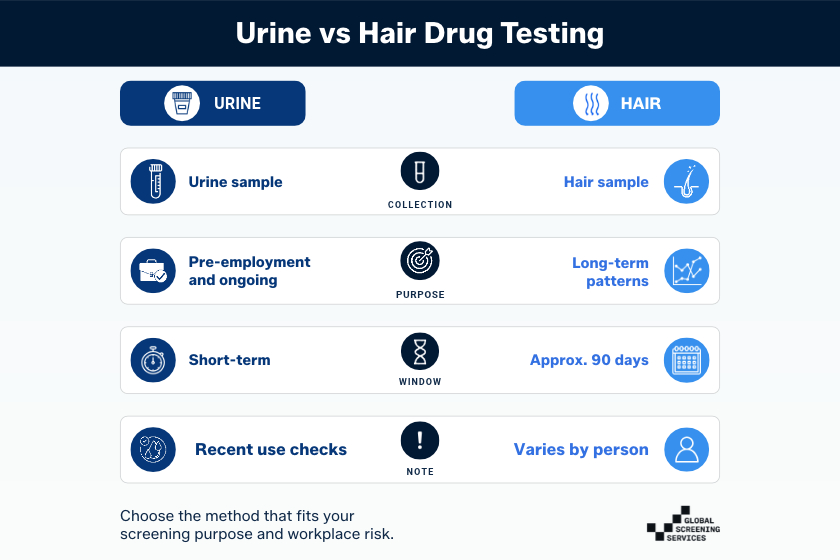
Urine Drug Testing
Urine testing is used for short-term detection of recent substance consumption. It can be considered for pre-employment and ongoing workplace screening, depending on the organisation’s requirements.
Hair Drug Testing
Hair testing provides a broader detection window and can help identify longer-term patterns of substance use. GSS describes its hair testing option as providing an approximate 90-day detection window.
Standard and Custom Drug Testing Panels
GSS offers four standard screening configurations and customised panels:
- 5-panel: Covers amphetamines, cocaine, marijuana (THC), opiates and phencyclidine (PCP).
- 6-panel: Includes the 5-panel substances plus benzodiazepines.
- 9-panel: Adds barbiturates, methadone and propoxyphene to the core screening.
- 12-panel: Covers extended opioids, synthetic stimulants and additional substances.
- Custom panel: Allows organisations to add or remove substances according to industry risks and client requirements.
What Should Employers Consider Before Conducting Workplace Drug Testing?
Before introducing employee drug screening, organisations should establish procedures that address legal, operational and privacy requirements.
- Legal requirements: Review applicable employment, privacy and industry-specific regulations.
- Consent: Explain the screening process and obtain appropriate consent or authorisation where required.
- Confidentiality: Protect sensitive health information and restrict access to authorised personnel.
- Consistent policies: Apply screening procedures fairly and avoid discriminatory practices.
- Accurate results: Use appropriate laboratory processes and review flagged results carefully.
- Result interpretation: Consider legitimate prescription use and arrange suitable review where necessary.
Employer’s Pre-Testing Checklist
- Define the purpose of testing.
- Identify relevant employees or roles.
- Select the appropriate collection method and drug panel.
- Review applicable legal and privacy requirements.
- Obtain consent where required.
- Arrange secure sample collection.
- Review flagged results appropriately.
- Maintain confidential screening records.
How Can Companies Establish an Effective Employee Drug Testing Programme?
A structured programme helps organisations manage screening consistently. GSS conducts its drug screening process in four stages:
- Define and Select: Choose urine or hair collection and the required drug panel based on industry risks or client mandates.
- Consent and Collection: Candidates provide formal consent through the secure platform, followed by sample collection under established protocols.
- Lab Analysis and Quality Assurance: Samples are processed through GSS’s laboratory partners.
- Final Report: Receive a structured report to support onboarding or project deployment decisions.
This process helps organisations align screening requirements with their operational needs while maintaining a defined collection and reporting workflow.
How Can Global Screening Services Support Workplace Drug Testing?
Global Screening Services (GSS) provides Drug & Medical Screening solutions for organisations in manufacturing, logistics, maritime and other high-stakes environments. Its services include urine and hair testing, standard 5-, 6-, 9- and 12-panel configurations, and customised screening options. GSS also facilitates random and periodic screening to support ongoing workplace safety and compliance.
Explore GSS Drug & Medical Screening Services to understand the available screening options.
Frequently Asked Questions
1. When Should Companies Conduct Employee Drug Testing?
Companies may conduct drug testing before employment, randomly, periodically or following a workplace incident or documented reasonable suspicion. The appropriate timing depends on the role, workplace risks, company policy and applicable regulations.
2. Is Drug Testing Mandatory Before Employment?
Pre-employment drug testing is not universally mandatory for every job. It may be required by specific industry regulations, client contracts or organisational policies. Employers should confirm the applicable requirements before introducing screening.
3. Can Employers Conduct Random Drug Testing on Employees?
Employers may consider random testing where it is permitted by applicable laws and supported by a clear workplace policy. Selection procedures should be consistent, transparent and appropriate to the roles being screened.
4. What Is Reasonable Suspicion Drug Testing?
Reasonable suspicion testing may be considered when objective, documented observations create a legitimate concern about possible workplace impairment. Employers should follow established procedures rather than relying on assumptions or unverified allegations.
5. What Is the Difference Between Urine and Hair Drug Testing?
Urine testing is used to screen for relatively recent substance consumption, while hair testing provides a broader detection window. GSS describes its hair testing option as providing an approximate 90-day window.
6. Can Companies Conduct Random or Periodic Drug Screening?
Yes. GSS facilitates random and periodic screenings to help organisations support ongoing workplace safety and compliance. The screening schedule should be based on organisational requirements and applicable regulations.