Hiring the right candidate involves more than reviewing a resume and conducting an interview. Employers need to ensure that the information provided by applicants is accurate, complete and reliable.Background screening helps organisations verify a candidate’s identity, educational qualifications, employment history and other relevant details before making hiring decisions. Without properbackground screening for employment, businesses may face risks associated with false credentials, inaccurate work experience, identity discrepancies and potential compliance issues. A structured screening process allows HR professionals and recruiters to make informed hiring decisions while maintaining workplace safety and trust. Understanding its key components helps employers select the right checks for each position.
1. What Is Background Screening and Why Is It Important?
Background screening is the process of verifying a candidate’s personal, educational, professional and other relevant information to assess their suitability for a job. It helps employers validate application details and identify discrepancies before completing the recruitment process.
Understanding Employment Screening
Employment screening involves conducting relevant verification checks based on a candidate’s job responsibilities, industry requirements and organisational policies. Some database-led and API-based checks, such as identity, database and UAN checks, may be completed before onboarding. Education, employment and other source-based verifications are generally undertaken during the onboarding process, subject to the agreed screening scope.
The scope of screening varies depending on the industry, position and applicable regulations. For example, financial institutions may require additional financial probity checks, while healthcare organisations may need role-specific medical and compliance checks.
Importance of Employment Screening
Employment screening supports a more reliable recruitment and onboarding process by helping employers:
🟦 Verify the accuracy of information provided by candidates.
🟦 Identify discrepancies in qualifications and employment records.
🟦 Reduce potential hiring and workplace risks.
🟦 Support regulatory and industry compliance.
🟦 Build a trustworthy and accountable workforce.
2. Common Components of Background Screening
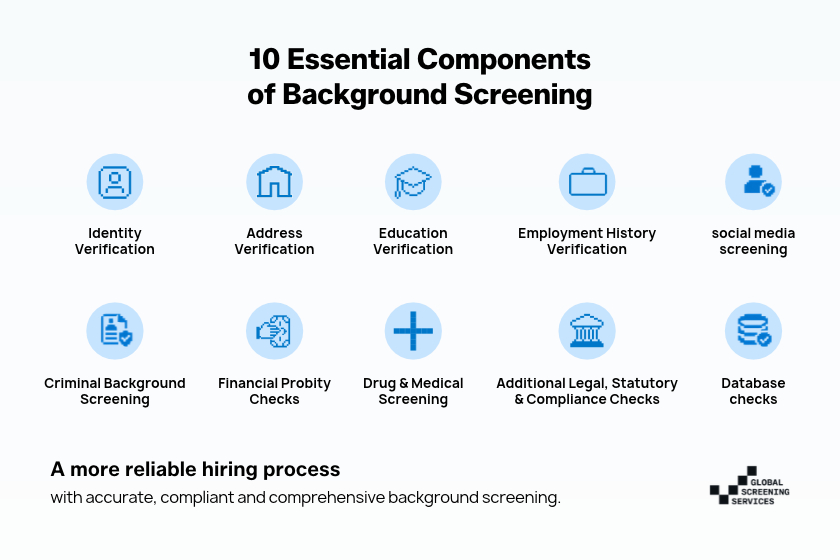
A comprehensive background screening programme can include several verification checks. The following eight components help employers assess different aspects of a candidate’s personal and professional information.
| Screening Component | What It Verifies | Key Purpose |
|---|---|---|
| Identity Verification | Personal details and identification | Confirm candidate identity |
| Address Verification | Current and permanent addresses | Validate residential information |
| Education Verification | Degrees, certificates and qualifications | Confirm academic credentials |
| Employment Verification | Previous employers, job titles, designations, employment dates, roles and re-hire eligibility, where available | Validate professional experience |
| Legal History Screening | Relevant criminal records and legally accessible court or case records | Assess role-related risks |
| Database Checks | Relevant AML, PEP, international database and adverse media checks, where appropriate | Assess role-related risks |
| Financial Probity Checks | Relevant financial records | Evaluate financial responsibility |
| Drug and Medical Screening | Relevant drug tests and medical fitness | Address workplace safety requirements |
| Legal, Statutory and Compliance Checks | Licences, registrations and regulatory records | Confirm professional and legal eligibility |
| Social Media Screening | Relevant, publicly accessible social media information, where lawful and role-related | Identify relevant public information that may require review under the employer’s screening policy |
2.1 Identity Verification
Identity verification confirms whether a candidate’s personal information matches their submitted identification documents and available official records. It may involve checking government-issued identification, names, dates of birth and other relevant details.
This check helps employers identify identity discrepancies, incorrect information or potential impersonation. Accurate identity verification also provides a foundation for conducting other background checks.
2.2 Address Verification
Address verification confirms the residential address provided by a candidate through different verification methods. Common approaches include Digital Address Verification, supported by a geotagged report; Speed Post with Proof of Delivery; and Physical Point of Contact Verification. These methods help establish address authenticity through location-based evidence, postal delivery confirmation, and physical verification.
Address verification may also involve skip-tracing techniques to identify a candidate’s previous or associated addresses. This can help establish address history independently of the details provided by the candidate and support a more comprehensive assessment of residential information.
2.3 Education Verification
Education verification confirms the academic qualifications mentioned in a candidate’s application or resume. This may include checking:
- University or educational institution details.
- Degree and diploma qualifications.
- Certificates and professional courses.
- Year of enrolment and graduation.
- Other relevant academic credentials.
For positions requiring specific educational qualifications, this check helps employers confirm that candidates meet the stated academic requirements.
2.4 Employment History Verification
Employment history verification validates the professional experience provided by a candidate by contacting their previous employer through HR outreach. As part of this process, the HR representative is asked to confirm the candidate’s employment details and provide information about their previous employment record.
- Common details verified through HR outreach include:
- Employee name and employee ID.
- Previous organization name.
- Employment dates.
- Last position held.
- Reason for discontinuation of service.
- Eligibility for rehire.
- Whether the applicant was involved in or reprimanded for any workplace misconduct, indiscipline, or violation of company policies.
- Status of exit formalities and Full & Final Settlement (completed or pending).
- Whether any pending matters remain with the employer or employee.
- Additional remarks from the verifier, where applicable.
The verification also records the respondent’s name, designation, and contact details to establish the source of the confirmation.
This process helps employers validate a candidate’s previous employment information, understand their exit status, and identify any relevant workplace conduct or compliance concerns before making an onboarding decision.
2.5 Database Checks
Database checks compare relevant candidate information against appropriate databases and screening sources. Depending on the role and agreed scope, these may include AML, politically exposed person (PEP), international database and adverse media checks.
These checks can help employers identify relevant risk indicators that may not be apparent from a CV or standard employment records. The sources and parameters used should be appropriate to the position and applicable requirements.
2.6 Legal History and Criminal Record Screening
Legal history screening involves checking relevant criminal records and other legally accessible court or case records through appropriate sources, subject to applicable laws and regulations.
Depending on the jurisdiction and screening requirements, checks may include available court records, police verification and other legally accessible records. The scope should be relevant to the role and conducted in accordance with applicable law.
This check can be particularly relevant for positions involving financial responsibilities, sensitive information, vulnerable individuals or workplace security. Employers should assess any findings fairly, considering their relevance to the role and applicable legal requirements.
2.7 Financial Probity Checks
Financial probity checks assess relevant financial information where appropriate for a candidate’s responsibilities. They are particularly important for positions involving financial management, banking, accounting or access to sensitive financial assets.
Depending on local regulations and available records, these checks may involve reviewing relevant financial or credit-related information.
Financial probity screening helps employers evaluate potential financial risks while ensuring that checks are conducted lawfully and are relevant to the position.
2.8 Drug and Medical Screening
Drug and medical screening involves relevant tests or assessments to determine whether a candidate meets specific workplace health and safety requirements.
Drug testing may be required for safety-sensitive positions, depending on organisational policies and applicable regulations. Medical screening may assess job-related fitness or specific occupational health requirements.
Employers should ensure that these checks are conducted with appropriate consent, confidentiality and compliance with applicable employment and privacy laws.
2.9 Legal, Statutory and Compliance Checks
Some positions require additional checks beyond standard identity, education and employment verification.
These checks may include:
🟦 Sanctions or watchlist screening, where relevant.
🟦 Statutory and industry-specific compliance checks.
Such additional checks help employers confirm that candidates meet the legal and professional requirements associated with particular roles.
2.10 Social Media Screening
Social media screening reviews relevant, publicly accessible online information associated with a candidate, where permitted by applicable law and the employer’s screening policy. It should focus on information that is directly relevant to the role and should not be used to make assumptions about a candidate’s personal characteristics.
Any findings should be assessed consistently, documented appropriately and handled with due regard for privacy, fairness and applicable employment requirements.
Important Insight: Background screening is not a one-size-fits-all process. The right combination of verification checks depends on the candidate’s job responsibilities, industry requirements and applicable regulations. Employers should focus on relevant, lawful and proportionate checks rather than conducting unnecessary verifications.
3. How Does the Employment Screening Process Work?
The employment screening process typically follows a structured, seven-stage workflow to verify a candidate’s employment details and assess the accuracy of the information provided. The process includes the following stages:
1. Candidate Submission and Consent
The process begins when candidate details and supporting documents are received through the agreed intake channel. Candidate documents are collected on a consent-based basis, and the required authorisation is obtained before checks begin.
2. Document Validation
The candidate’s declared details are cross-checked against the supporting documents provided. This validation is carried out for each verification component.
3. Verification Initiation:
Each verification check is initiated according to the procedures established by the relevant source, such as a previous employer or educational institution. This stage involves identifying the appropriate verification route, required documents, applicable payment procedures, and typical turnaround times.
The initiation process may also need to accommodate client-specific requirements, such as designated submission channels, authorised email addresses, or additional supporting documents.
4. Cadence-Led Follow-Up
Once initiated, each component follows a defined follow-up cadence based on source procedures and response patterns. Where a source has an unusually long turnaround time, the client is informed with the reason rather than waiting until the case becomes overdue.
5. Validation of Source Confirmation
When a response is received, it is checked against the candidate’s submitted information and documents to identify discrepancies or mismatches.
6. Verification Outcome Decision
The verifier assesses the available findings and records the appropriate outcome. The result should reflect the source confirmation and supporting evidence.
7. Quality Control and Quality Assurance
Before the report is released, each verification component undergoes a quality review to check the recorded outcome and supporting information.
Quality Review and Reporting
The component-level quality review checks the recorded findings before the final report is released. Any discrepancy or incomplete information is handled in line with the agreed reporting process.
Clients can receive status updates and review the findings through the agreed reporting channel or platform.
Final Report and Onboarding Review
Once the required checks are completed and quality-reviewed, the report is shared with the authorised employer or HR team. The employer can review the verified information and determine the appropriate next steps in the onboarding process.
Background Screening Process: A Quick Checklist
- Collect candidate information and relevant documents.
- Obtain the necessary candidate consent.
- Identify the verification checks required for the role.
- Initiate each component through its appropriate source-specific procedure.
- Validate source responses, assess outcomes and complete quality checks.
- Prepare and share the final screening report.
- Review findings before completing employee onboarding.
4. How to Choose the Right Background Screening Service?
Selecting a background screening provider requires more than comparing service offerings or turnaround times. Employers should assess the provider’s verification accuracy, industry experience, data security practices, client reputation, and technology capabilities to ensure that screening results are reliable and candidate information is handled responsibly.
Verification Accuracy and Quality Assurance
Verification accuracy is one of the most important factors when choosing a screening provider. Look for structured verification procedures, reliable information sources, and documented quality assurance measures.
A dependable provider should have a clear process for validating information, resolving discrepancies, following up with verification sources, and reviewing findings before releasing reports.
You can also assess the provider’s track record by asking about contested verifications, discrepancy rates, and quality review procedures. For example, a record of zero contested verifications can indicate consistency in reporting, provided the claim is supported by documented results and a clearly defined period. However, this metric should be considered alongside the provider’s overall verification methodology.
Verification Methodology and Source Quality
Understand how the provider conducts different types of background checks and identifies appropriate verification sources. A structured methodology should define the verification route, required documentation, follow-up process, and evidence used to support each outcome.
Where possible, prioritise providers that verify information through authorised institutions, previous employers, official records, or other relevant primary sources. Direct-source confirmation and documented evidence can provide greater transparency and traceability than relying solely on stamps, signatures, or unverified contact details.
Data Security and Relevant Certifications
Background screening involves collecting and processing sensitive personal, educational, and employment information. Therefore, data security should be an essential consideration when selecting a provider.
Check whether the provider follows recognised information security standards and holds relevant certifications, such as ISO/IEC 27001 for Information Security Management Systems and ISO 9001 for Quality Management Systems. Also, review its data protection practices, access controls, retention policies, and procedures for secure data deletion.
Depending on the applicable jurisdictions, employers should also consider the provider’s approach to relevant data protection requirements, including GDPR and India’s Digital Personal Data Protection (DPDP) framework.
Industry Experience and Client Reputation
A provider’s experience can offer insight into its understanding of verification procedures, institutional requirements, and industry-specific screening needs. Consider the number of years it has operated in the background screening industry and whether it has experience supporting organisations of different sizes and sectors.
Client reviews, testimonials, and case studies can help employers understand how a provider performs in practice. Look for feedback relating to verification accuracy, communication, turnaround times, issue resolution, and consistency of service. Where possible, review independent client feedback rather than relying exclusively on testimonials published by the provider.
Smart Screening and Reporting Technology
Technology can make background screening easier to manage by simplifying document collection, verification tracking, communication, and report management.
When evaluating a provider’s technology, consider whether it offers secure candidate intake, HRMS or API integrations, centralised dashboards, and configurable reporting. Role-based access controls can help ensure that users only access information relevant to their responsibilities.
Clear status updates, audit trails, and Management Information System (MIS) reports can also help HR teams monitor verification progress, identify delays, and maintain visibility across multiple candidates and locations.
5. Final Thoughts: Building a Reliable Hiring Process Through Background Screening
Background screening plays an important role in helping employers make informed and responsible hiring decisions. From identity and address verification to education, employment history, criminal records, and additional compliance checks, each component provides valuable information about a candidate.
However, every position has different requirements. Employers should select screening checks according to job responsibilities, industry standards, and applicable regulations rather than applying an identical screening package to every candidate.
Choosing an experienced background screening provider is equally important. Employers should consider the provider’s verification methodology, source reliability, data security practices, quality assurance procedures, and ability to support different screening requirements.
Established in 2004, Global Screening Services (GSS) brings more than 22 years of background verification experience, with verification coverage across 76+ countries. Its approach emphasises accountability, integrity, innovation, and thoroughness, with a focus on source-based verification, documented evidence, and responsible reporting.
Understanding these factors can help organisations develop a screening process that is appropriate for their workforce, supports informed hiring decisions, and contributes to a more reliable recruitment process.
To learn more about background screening and verification services, visit Global Screening Services.
Frequently Asked Questions
1. What are the common components of employment screening?
The 10 components may include identity verification, address verification, education verification, employment verification, database checks, legal history screening, financial probity checks, drug and medical screening, statutory and compliance checks, and social media screening. The exact scope depends on the role and applicable requirements.
Common checks include identity, address, education, employment and legal history verification. Additional checks may be included according to the candidate’s role, industry and the employer’s screening policy.
2. What checks may be completed before onboarding?
Some database-led and API-based checks, such as identity, database and UAN checks, may be completed at the interview stage. Other verifications, including education and employment verification, are generally undertaken during onboarding, depending on the agreed scope and source requirements.
3. How does employment verification confirm work history?
Employment verification typically involves contacting an appropriate, authorised source at a previous employer or reviewing authorised employment records. Depending on source availability, it may confirm employment dates, designation, role, re-hire eligibility and other agreed details.
4. How long does the employee background screening process take?
The duration varies depending on the number and type of checks, candidate documentation, response times from institutions and employers, and the availability of verification records. Some checks may be completed quickly, while others involving multiple institutions or jurisdictions may take longer.